
Home › Services › Cat5e, Cat6 and Cat6A cabling and network point certification
Cabling certification: every network point measured, not just tested
A network point that "lights up" is not a compliant network point. With a certification tester we measure every Cat5e, Cat6 and Cat6A copper link and every fibre link to the relevant standards, and hand over a report with the measured values: proof that the cabling carries the speeds you paid for, today and with tomorrow's equipment.
Based in Quartu Sant'Elena · on-site work in Cagliari, its metropolitan area and all of Sardinia
- Cat5e · Cat6 · Cat6Acopper certified up to 10 Gbit/s
- Every pointmeasured, labelled and listed in the report
- Since 2004designing, installing and certifying cabling in Sardinia
- The whole islandoffice in Quartu Sant'Elena, working across Sardinia
Cat5e, Cat6 and Cat6A cabling and network point certification: from design to support
Measurement and certification of every Cat5e, Cat6 and Cat6A copper network point and every fibre link, to standard, with report and labelling.
Cat5e, Cat6 and Cat6A certification
Measurement of every permanent link or channel against its declared category and class: D, E and EA.
Measurements to standard
Tests to ISO/IEC 11801, EN 50173 and ANSI/TIA-568: wire map, length, insertion loss, crosstalk, return loss and delays.
A report for every point
Pass or fail, measured values and margins for every outlet, in a report to attach to the acceptance test.
Labelling and map
Outlets, patch panels and cabinets labelled with the same code as the report: every point is found in a moment.
Fibre optics
Link loss measurement and, where needed, OTDR testing of splices and connectors.
Fix and re-test
Non-compliant points are found, repaired or redone and certified again, until the report is complete.
How we certify cabling
A tester only tells you whether the wires are connected. Certification tells you whether the cabling really carries the speed of its category: that is what matters for switches, access points and cameras.
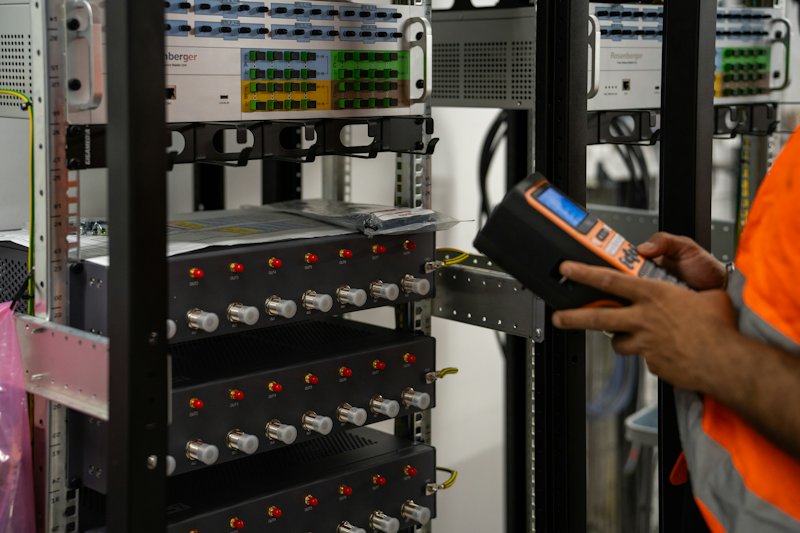
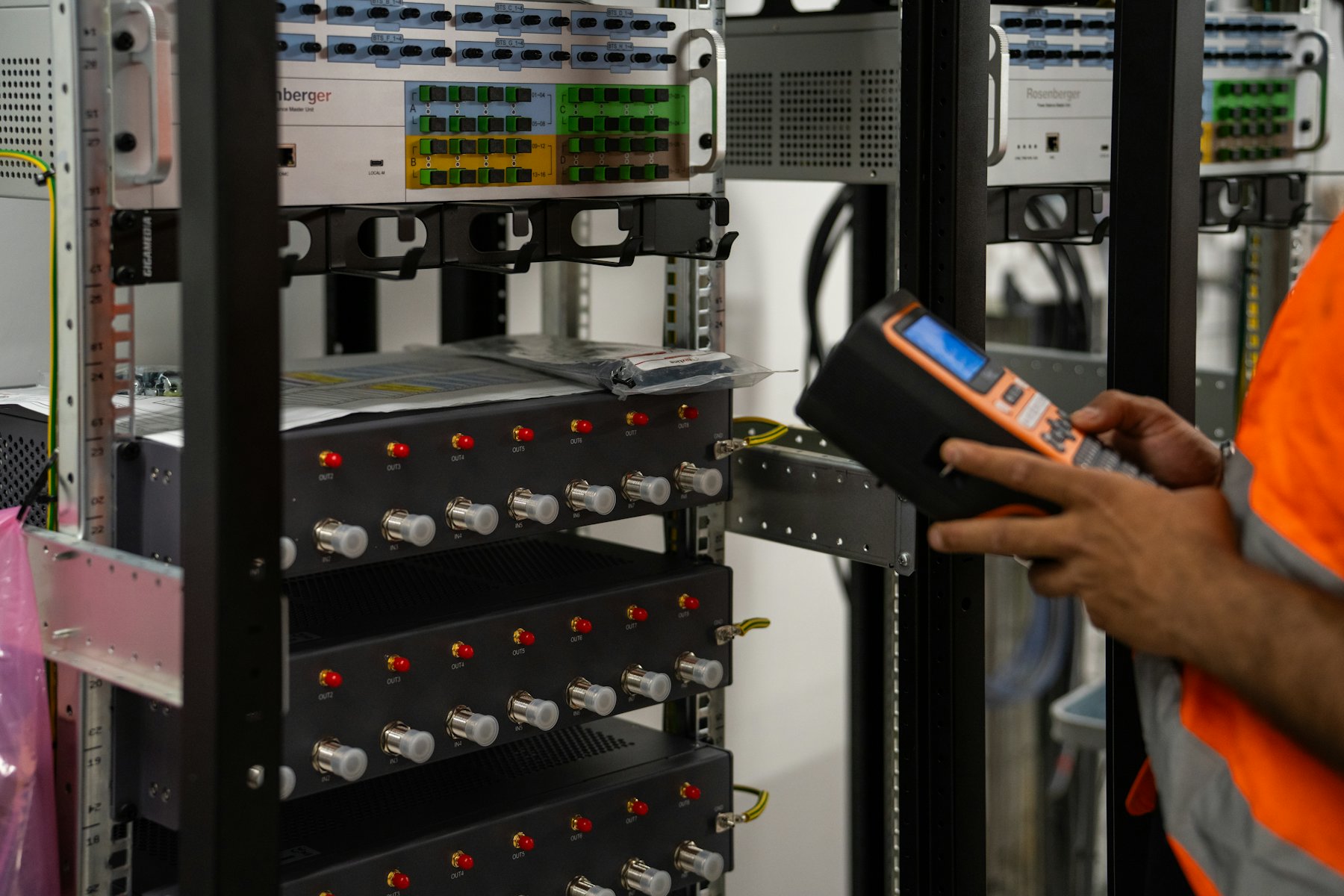
Every network point measured, not just tested
With the certification tester connected at both ends, every point is measured in a few seconds on all the parameters its category requires. The result is not "it works", but a value compared with the limits of the standard.
- Wire map: reversals, split pairs, opens
- Length and propagation delay
- Insertion loss, crosstalk (NEXT) and return loss
- Margin against the category limits
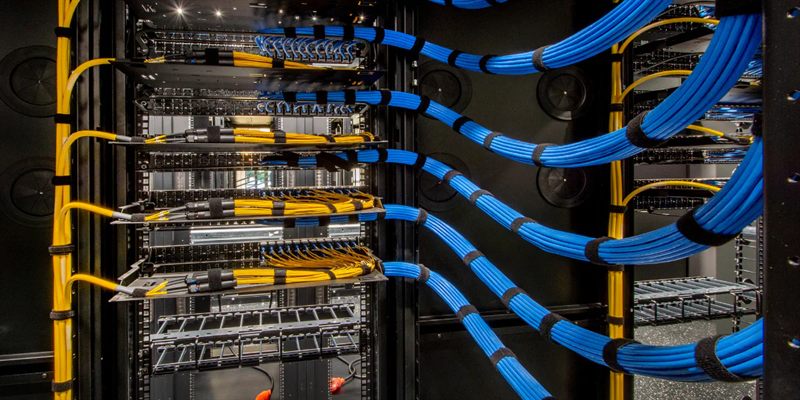
Cat5e, Cat6 or Cat6A: the right one for today and tomorrow
The category decides the speed the cabling can carry. We help you choose based on the equipment you will use in the coming years, not just today.
- Cat5e: up to 1 Gbit/s, for existing systems
- Cat6: up to 10 Gbit/s, but only on links up to 55 metres
- Cat6A: 10 Gbit/s over the full 100 metres
- PoE power for Wi-Fi access points and cameras
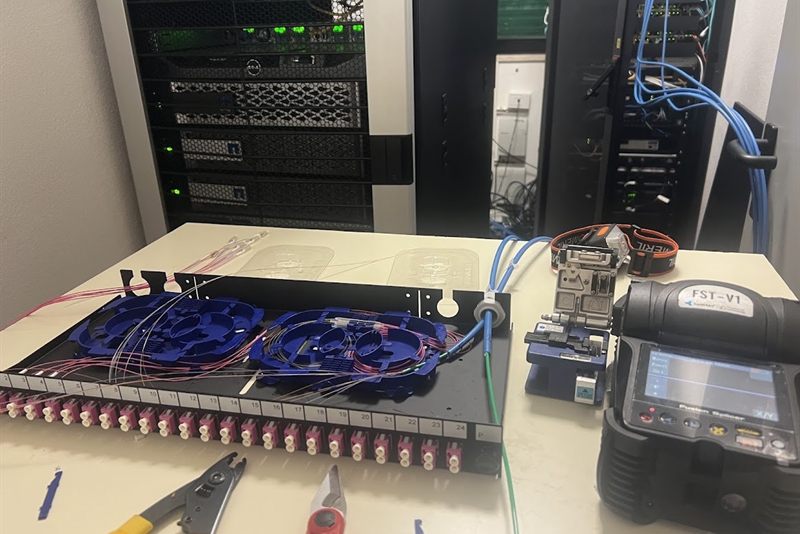
Fibre backbones too, splice by splice
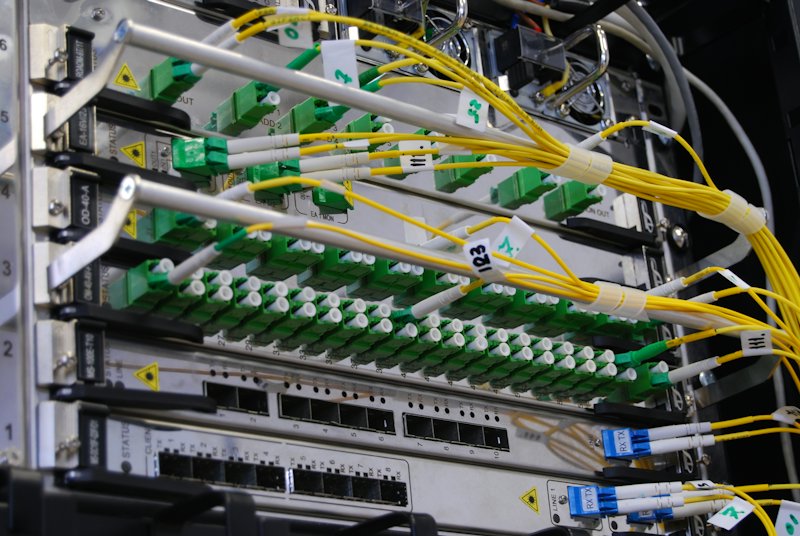
Fibre links between floors and buildings are measured for loss and, where needed, with an OTDR, which shows every splice and connector along the line. Pictured: one of our jobs, splicing and terminating a fibre-optic backbone in a server room.
- Multimode and single-mode fibre
- Link loss measurement
- OTDR testing of splices and connectors
- One report together with the copper
Checking cabling that is already installed
Before replacing switches, moving to next-generation Wi-Fi or relocating to new offices, we measure the cabling you have: find out which points carry the new speeds and which need redoing, without replacing everything.
- Certification of cabling installed by others
- Finding faulty points
- Repair and re-test
- A clear proposal of what to redo and what to keep
From the site survey to the certification report
A simple process, for a new or an existing system.
- 01
Site survey
Cabinets, network points, declared category and existing documentation.
- 02
Test plan
List of points and links to certify, with their labelling codes.
- 03
Measurements
Certification of every copper point and every fibre link with a calibrated instrument.
- 04
Fixes
Non-compliant points are repaired or redone and measured again.
- 05
Report
Full report with measured values, point map and labels.
- 06
Support
New points, moves and extensions certified with the same method.
Tailored solutions for every environment
Every project starts with a site survey: spaces, users, existing systems and goals. We often work with:
- A clear proposal with materials, timing and costs
- Tidy work and full documentation
- Support with tickets and remote assistance
Cat5e, Cat6 and Cat6A cabling and network point certification in Cagliari and Sardinia
Our office is in Quartu Sant'Elena, right next to Cagliari: we work for companies, public bodies and facilities in Cagliari, across its metropolitan area and throughout Sardinia. Every project starts with an on-site survey; after installation, support continues with tickets, remote assistance and on-site visits.
Cat5e, Cat6 and Cat6A cabling and network point certification: common questions
What is the difference between testing and certifying a network point?
A simple tester only checks that the wires are connected in the right order. Certification measures the electrical parameters of the link and compares them with the limits of the standard for its category: it is the only way to know whether the point really carries 1 or 10 Gbit/s.
Cat6 or Cat6A: which is better?
For new installations we often recommend Cat6A: it carries 10 Gbit/s over the full 100 metres and handles PoE power for access points and cameras better. Cat6 reaches 10 Gbit/s only on short links, up to 55 metres.
Can you certify cabling installed by others?
Yes. We measure the existing cabling, tell you which points comply and which do not and, if you wish, fix the faulty ones and certify them again.
What is the certification report for?
It documents the acceptance test of the system, is often required in specifications and public tenders, supports cabling-system manufacturer warranties and becomes the reference map for every future job.
How long does it take?
Measuring a single point takes a few seconds: the total time depends mainly on the number of points and on access to offices and cabinets. We organise the work so as not to stop yours.
Do you work outside Cagliari?
Yes, across Sardinia: our office is in Quartu Sant'Elena and we travel with instruments and team wherever needed.
Do you also work outside Cagliari?
Yes. Our office is in Quartu Sant'Elena, right next to Cagliari: we work in Cagliari and its metropolitan area and organise site surveys, installations and support throughout Sardinia, including Sassari, Olbia, Nuoro, Oristano. Support also continues remotely with tickets and remote assistance.
Often delivered together
Structured cabling and fibre optics
Copper and fibre optics, tidy rack cabinets, labelling and certification of every link.
Learn more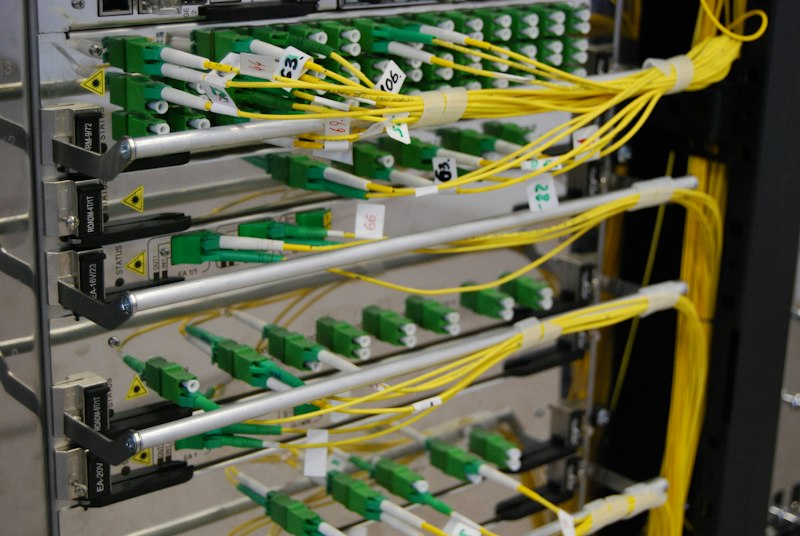
Fibre optics: installation, splicing and certification
Fibre backbones and links between floors, buildings and sites: installation, fusion splicing, patch panels and measurement of every link.
Learn more
Business networks and Wi-Fi
Professional wired networks and Wi-Fi, designed around your real spaces and number of users.
Learn more
Data centres and server rooms
Design and construction of data centres and server rooms, from the empty room to ongoing support.
Learn moreLet's talk about your project
A site survey with no obligation to understand your spaces, needs and existing systems.